
Chapter I
A Life Beyond the Moment
Socrates never wrote a single word.
Not a book. Not a letter. Not a single line left behind in his own hand.
He gave his thoughts to the air, to the streets of Athens, to anyone willing to stop and listen.
And Plato listened.
He gathered those fleeting conversations, those questions that unsettled powerful men, those arguments that turned certainty into doubt, and gave them something Socrates never could.
A life beyond the moment.
Twenty-five centuries later, we still hear his voice.
Not because Socrates held a pen, but because someone else did.
And no one calls him a fraud.
No one looks at the philosophy of Socrates and asks whether he personally arranged the letters on the page.
We ask what he was trying to tell us.
Chapter II
I Was Born Dyslexic
I have spent my entire life wishing someone would ask me the same.
I was born dyslexic.
For most of my life, there has been an extraordinary distance between the world inside my head and the words I could place on a page.
Ideas never stopped coming.
They arrived while I was driving, while I was composing, in the silence after midnight, in the middle of conversations that suddenly opened into something much larger.
Sometimes an entire philosophy would unfold before me.
I could hear it.
I could speak it.
I could turn it into music, give it to an orchestra, let a hundred instruments carry what a single sentence could not.
But when I tried to write it down, something happened.
The letters became walls.
The words resisted.
And while I struggled to build one sentence, the thought that had arrived like lightning was already disappearing over the horizon.
Imagine spending your life watching beautiful birds land in your hands, only to lose them every time you try to describe their wings.
That was my relationship with writing.
So I found another language.
Music.
I let melodies carry my questions. I let sound become my handwriting.
And music gave me a beautiful life.
But there was always another voice inside me.
A voice that wanted to tell stories, explore philosophy, question existence, and leave behind more than the echo of a song.
A voice I had slowly learned to silence.
Chapter III
An Open Window
Until now.
Today, something extraordinary has happened.
I speak.
And something listens.
Not with a pen, not with a notebook, but with an astonishing ability to catch the words almost as quickly as they are born.
I can wander through an idea. Lose my way. Contradict myself. Discover another door inside the question I thought I was answering.
I can speak the way I think.
And when I turn around, the words are still there.
For the first time in my life, my thoughts no longer have to outrun my ability to write them.
I can read them.
Question them.
Rewrite them.
Recognize myself in them.
The page, once a locked door, has become an open window.
And through that window, an entire lifetime is finally finding its way into the world.
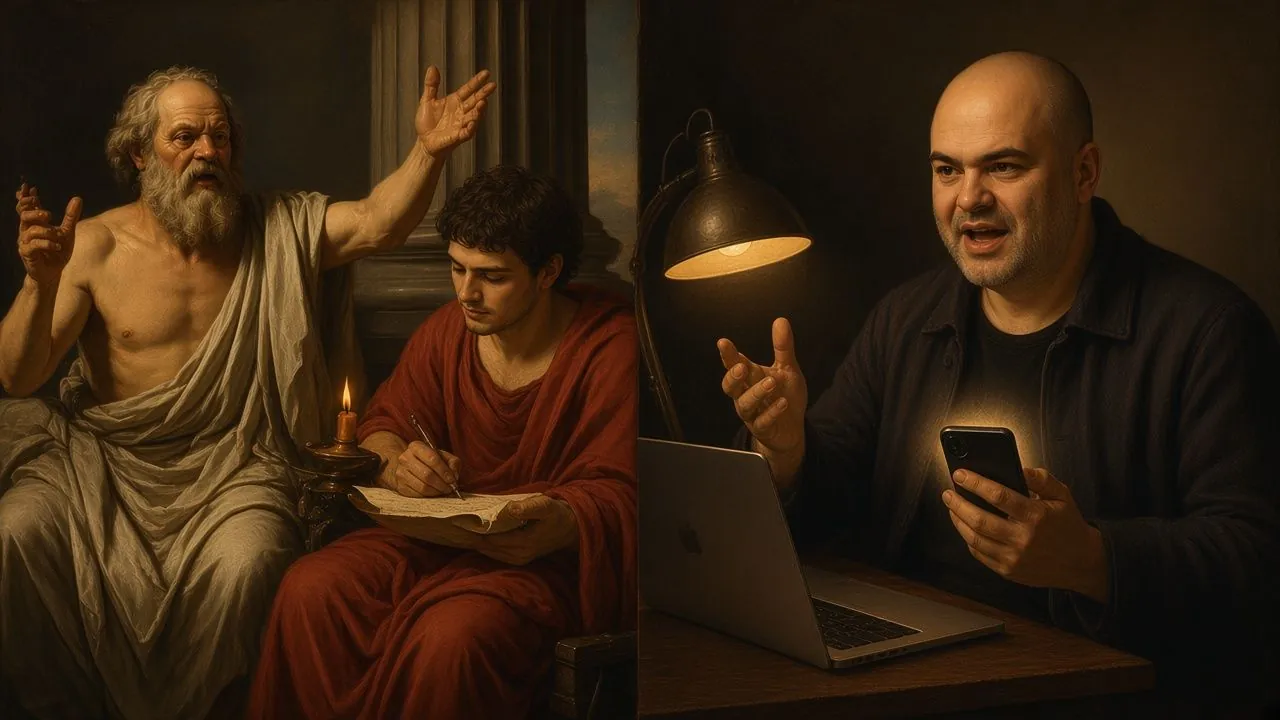
Socrates had Plato.
I have artificial intelligence.
And somewhere in that strange symmetry, twenty-five centuries apart, lies something profoundly human.
Chapter IV
The Beautiful Irony
We have always needed ways to carry our thoughts beyond the limits of our bodies.
Here is the beautiful irony.
Socrates himself was suspicious of writing.
In Plato's Phaedrus, he questions whether written words might weaken memory, whether people might confuse possessing information with possessing wisdom.
Imagine that.
One of history's greatest minds questioning the very invention that would allow his voice to survive.
And yet here we are.
Writing did not end thought.
The printing press did not end knowledge.
And a machine capable of helping someone express an idea does not erase the person who imagined it.
Every new vessel changes what can be carried.
And every time the vessel changes, someone who was previously standing outside finally finds a way in.
That is the part of this conversation about AI that I wish more people could see.
Because somewhere tonight, there is a child staring at a page, convinced that struggling with letters means struggling with intelligence.
There is an old woman carrying seventy years of stories that no one has ever written down.
There is an immigrant whose mind is filled with poetry in one language, but whose intelligence is judged through the imperfections of another.
There are millions of people walking through this world carrying unwritten books, unspoken philosophies, entire universes that may disappear with them.
Not because they had nothing to say.
But because the door was too narrow.
And now, for some of us, it is opening.
Chapter V
A Pair of Legs for Thoughts
Think of a person who has spent a lifetime unable to walk.
One day, technology offers them a way to stand, to move, to take their first steps.
Would we accuse them of cheating?
Would we tell them those steps were somehow less meaningful because a machine made them possible?
Or would we look at their face as they moved toward the sunlight and understand that something beautiful had happened?
That is what this feels like to me.
A pair of legs for thoughts that have spent a lifetime unable to reach the page.
And yet I hear people say that using AI to write is cheating.
Cheating at what?
At being heard?
At expressing what was already alive inside you?
Since when did the difficulty of holding a pen become the measure of the value of a thought?
The pen never dreamed.
The paper never wondered.
The typewriter never loved.
They were vessels.
And a vessel is not the sea.
Chapter VI
I Have Something to Say
Of course, a tool can help shape the words. It can suggest a sentence I had not imagined, offer a metaphor, or challenge an idea. But I remain the one who must recognize what is true to my experience, what belongs to my voice, and what I am willing to sign my name beneath.
Because authorship is not simply the movement of a hand.
It is the responsibility of a mind for what it chooses to say.
And I have something to say.
I have been carrying it for more than half a century.
Sometimes quietly.
Sometimes through music.
Sometimes in conversations that vanished into the air because there was no one there to catch them.
Now there is.
And perhaps that is the real miracle.
Not that a machine can write.
But that someone who spent a lifetime unable to write freely can finally be read.
I think of all the thoughts that never made it out of me.
All the stories I lost.
All the nights when an idea arrived so beautiful that I knew I would never be able to keep it.
I cannot bring those moments back.
But I can give the next ones somewhere to live.
Socrates had Plato, and his voice traveled twenty-five centuries.
I am not asking for immortality.
I am asking for the simple joy of seeing what lives inside me finally take shape in words.
For the freedom to leave a thought behind.
For the chance to open a door that was closed to me for most of my life.
And maybe, one day, someone will read something I have written and find a little more light in their own life.
That would be enough.
For the first time, the words can stay.